|
The Intelligence Explosion Is Happening Now [Transcript] The Intelligence Explosion Is Happening NowWhat is the Intelligence ExplosionThe Intelligence Explosion refers to a concept invented by the statistician, I. J. Good. Good was interested in Bayesian statistics, and learned to play go from Alan Turing. In his own words:
- I. J. Good (1965)
Modern usageGood's concept has been used widely in modern times to support the idea that - at some point in the future, intelligent self-modifying machines will arise, and then an "Intelligence Explosion" will occur.Nick Bostrom expresses the idea as follows:
It appears much harder to get from where we are now to
human-level artificial intelligence than to get from there
to superintelligence. While it may thus take quite a while
before we get superintelligence, the final stage may happen
swiftly. That is, the transition from a state where we have
a roughly human-level artificial intelligence to a state
where we have full-blown superintelligence, with
revolutionary applications, may be very rapid, perhaps a
matter of days rather than years. This possibility of a
sudden emergence of superintelligence is referred to as the
singularity hypothesis."
The Intelligence Explosion Is Happening NowThis essay expounds on the thesis that the intelligence explosion is already happening.How can that possibly be - when Good defined his intelligence explosion as being the result of the existence of an ultraintelligent machine - and there are currently none of those in sight? The answer is that Good did not formulate his concept in such a way that it "carves nature at the joints" - and that - properly understood - the real underlying concept - to which the term "intelligence explosion" should properly refer - describes a process which is already ocurring. An intelligence explosion of the type which Good described does not logically require an "ultraintelligent machine" (i.e. a machine that can far surpass all the intellectual activities of any man however clever). All it needs is an intelligent system which is able to modify its own algorithm. We already have an intelligent system which modifies itself. It is known as "the man-machine symbiosis". Machines are already heavily involved in the design of other machines. No-one could design a modern CPU without the use of computers. No one could build one without the help of sophisticated machinery. The idea that machines will suddenly take over this task when they become smart enough seems naive. Rather there is a man-machine symbiosis involved the design of machine - with the "man" part being gradually replaced by machine elements.
Machine programmersMachines do not yet make expert computer programmers - but they already contribute massively to computer programming tasks:
Machines will gradually get better at these kinds of computer programming tasks - taking over an increasing quantity of the load from humans. This includes tasks that involve modifying their own source code.
The man-machine symbiosisThat the intelligence explosion can be applied to the man-machine symbiosis has been recognised before - notably by Eliezer Yudkowsky:
Of course, we have had brain-computer interfaces for decades. They involve keyboards, mice, eyes, arms, hands and software. Won't there be a sudden speed-up when sluggish humans are finally eliminated from the loop? Probably not. By that point, machine "code wizards" will be writing most of the code anyway - so progress will already be pretty rapid. However, humans will most likely want to keep an eye on their budding machine programmers for a while - so there will be regular code reviews. As confidence is gained in the results, the reviews will be needed less frequently. So: humans will probably not drop out suddenly - but rather gradually, with increasingly-infrequent compulsory code reviews. It is a fallacy to argue that today's machines are designed by humans, and - since the intelligence of individual humans is not increasing - the intelligence explosion has not started yet. Today's machines are actually designed by networks of humans with the help of machines. The machines are currently improving - and so are the networking technologies that link humans with other humans and with machines. Machines pre-process our sensory data, and post-process our motor outputs - and the results are smarter than we are alone. So: machine intelligence will not suddenly surpass humans. Rather, machines have been gradually beating humans - an application domain at a time - for decades now. A machine intelligence that is of "roughly human-level" is actually likely to be either vastly superior in some domans or vastly inferior in others - simply because machine intelligence so far has proven to be so vastly different from our own in terms of its strengths and weaknesses - so machines will take over tasks from humans gradually, a domain at a time as they increase in comptence. These considerations suggest that there will be no terribly sudden "intelligence explosion" which starts at some point in the future - rather, the intelligence explosion is happening now.
The origins of the intelligence explosionOne of Robin Hanson's slides illustrates exponential growth in brain size dating back to the origin of animals:
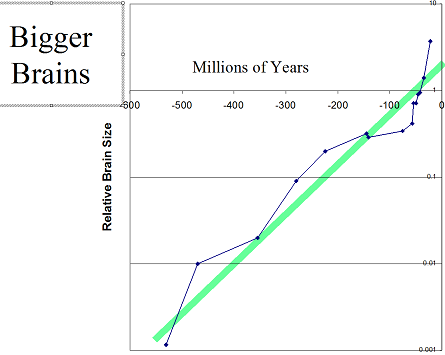
This graph is based on data from Harry Jerison's book: "Brain Size and the Evolution of the Mind."
The intelligence explosion can also be traced back through our hominid ancestors:
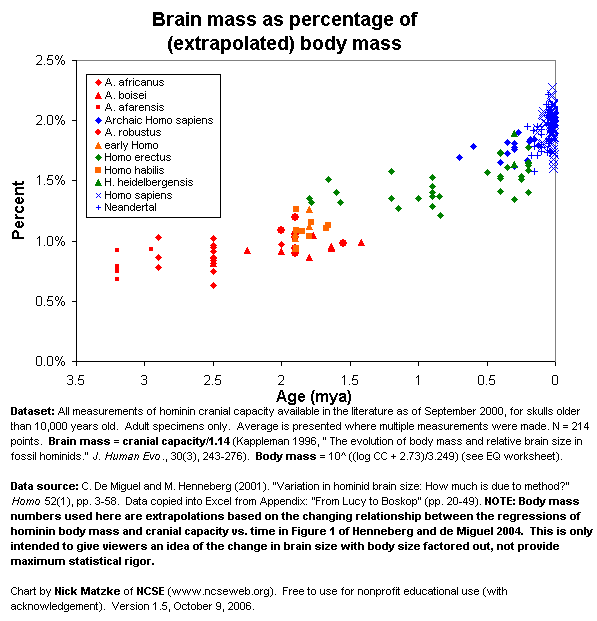
In modern times, intelligence has been augmented by networking technologies, that enable minds to be linked together, mind-machine interfaces, and the internet. Both humans and companies have increased in their intellectual abilities dramatically as a result. The origin of the intelligence explosion can be traced back to when evolution first developed simulation technology - in the form of brains, and began to perform evaluations under simulation. It accelerated when organisms began to select mates using intelligence. Use of non-nucleic inheritance accelerated the explosion further, as did tool use, networking and the internet.
Intelligent self improving systemsA kind of corollory of the point made in this essay is that there already exists an intelligent self improving system - namely the man-machine civilisation.I am not sure that this point is widely understood either. In the "Self-Improving Artificial Intelligence" talk listed in the reference section, Eric Drexler asks after an existence proof of an intelligent self-improving system. It does seem reasonable to me to point to the man-machine civilisation as an existence proof of an intelligent self-improving system - following God's Utility Function.
The technology explosionWe are in the midst of the "intelligence explosion" now. It is part of the ongoing "technology explosion", which affects many aspects of technology - not just intelligence.The "technology explosion" is really just another name for evolution - with pioneering adaptations being seen as a kind of natural technology - put together by tinkering, rather than by engineers. The technology explosion started long ago - and will likely reverberate into the future for some time to come.
References
|